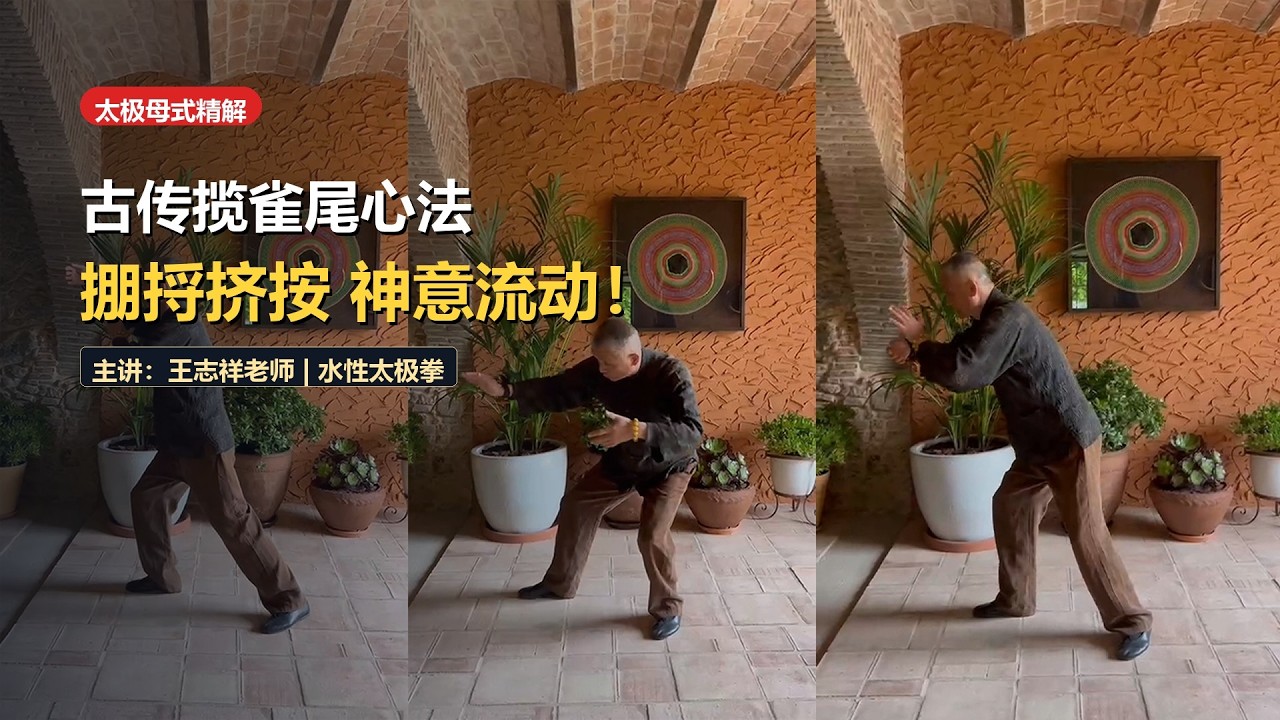
🌟 Executive Summary & Internal Martial Arts Context
Mastering the foundational architecture of Water Tai Chi requires a radical departure from conventional athletic training. Rather than building external muscular tension, internal martial arts focus on developing skeletal alignment, fascial elasticity, and spherical kinetic pathways. In this masterclass, Master Wang Zhixiang demystifies the ancient biomechanical principles that allow a practitioner to remain effortless yet immovable.
- Biomechanical Efficiency: Transmuting muscular tension (Li) into relaxed internal power (Jin) through postural sinking and joint release.
- Fascial Elasticity: Establishing an unbroken kinematic chain from the soles of the feet through the spine to the fingertips.
- Mind-Qi Regulation: Cultivating a calm, centered state of internal awareness (Ting Jin) to regulate breath and posture simultaneously.
📜 Complete Masterclass Lecture Transcript & Commentary
The following instructional transcript documents Master Wang Zhixiang's verbal transmission during this live lesson, segmented into core progression chapters with accompanying internal martial cues:
00:00 - 02:28 Chapter 1: Direct Technical Transmission
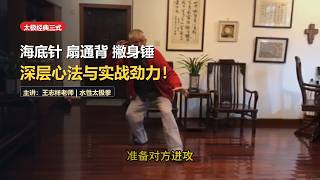
Good morning, dear teachers, martial artists, and Tai Chi friends. Today is May 30, 2023. International Children's Day is approaching in June. So let us celebrate a 'Senior Children's Day' together! Today I would like to the second posture, Grasp the Bird's Tail (Lan Que Wei). Last time we practiced the Opening Posture (Qishi), and received warm support and attention from so many practitioners. In just one single week, more than 1,400 teachers, fellow practitioners, and friends liked and viewed the video. I am deeply grateful to all of you. Your enthusiastic engagement is my greatest motivation to film these videos and share Water Tai Chi Form Two. Today I will demonstrate from the Opening Posture straight into Grasp the Bird's Tail. Sink the waist and drop the hips (Chen Yao Luo Kua). Rise. Arc smoothly forward. Sink the waist and drop the hips. Rise. Open at 45 degrees. Sink the waist and drop the hips. Move upward. Rise. Outward and downward at 45 degrees. Outward and upward at 45 degrees. Return to center. Sink downward. Turn. Sink the waist, drop the hips, extending forward and downward. Sit back on the rear leg. Turn the torso. Lift the foot. Forward. Backward. Turn. Ward Off (Peng). Roll Back (Lu).
Maintain the circular integrity of the crotch (Dang). Never allow the knees to collapse inward.
02:40 - 05:03 Chapter 2: Direct Technical Transmission
Press (Ji). Turn palms downward and forward at 45 degrees. Turn the waist. Sink the waist. Bow forward, casting the palms. Sit back, sink the waist, and drop the hips. Raise hands gently. Push forward (An). Very well. This sequence contains two vital movements: first is the Opening Posture, and the second is Grasp the Bird's Tail. Regarding the Opening Posture, let me offer additional guidance on how to practice it. Sink the waist and drop the hips. Rise, open hands at 45 degrees, and arc forward. Sink the waist, drop the hips, returning to center. Sink the waist, drop the hips, and rise. Open at 45 degrees. Outward 45 degrees, outward and upward 45 degrees, return to center, and sink. This Opening Posture can be practiced repeatedly. I will demonstrate it three times. We just did the first round. Descending the first time, downward, outward 45 degrees, outward-upward 45 degrees, return to center and sink. Rise, downward, outward, upward and inward 45 degrees, return to center, and sink. Exactly. This single movement, even before learning the subsequent postures, can be practiced as a standalone discipline, practiced repeatedly, at least 7 repetitions. After 7, practice 14 repetitions. practice 49 repetitions (seven times seven). Practicing 49 repetitions equals practicing an entire routine! Therefore, as long as you master this Opening Posture thoroughly, it will provide immense benefit
Breathe through the dantian rhythm; do not force air down, allow intra-abdominal pressure to soften.
05:07 - 07:27 Chapter 3: Direct Technical Transmission
for learning the entire Form Two routine. Why? Because the core essential keys are already inside. Now, let us examine what follows the Opening Posture. Here begins today's new sequence. Turning the body — here is an accumulation of potential (Xu Shi). Accumulating potential is paramount. Lift the foot, sink down, gliding forward like water, then sit back on the leg. Accumulate potential. Turn the torso, accumulate potential again. Lift the foot, bow stance, then sit back, accumulate potential. Turn the body, accumulating potential once more. This transitional section is what makes Form Two a true martial combat form (Ji Ji Quan Jia), designed to empower Tuishou (Push Hands) and martial combat application. it pays supreme attention to transitional movements. We call this section transitional mechanics. only when the bow is drawn fully and perfectly can the arrow fly true. So this section primarily trains transitional movements. The second characteristic of these transitions is centering on Xu Shi — accumulating power while awaiting release. Stored, ready to discharge. So when turning here, first is storing potential, then stepping and sinking down, then withdrawing to store power again, awaiting release. Then, Left Ward Off (Zuo Peng), store potential, turn, and store potential again. This sequence is extraordinarily brilliant. I notice that many modern forms have simplified and eliminated this section. Once simplified,
Notice the subtle warmth radiating from the center; this is the awakening of Primordial Yuan Qi.
07:30 - 09:52 Chapter 4: Direct Technical Transmission
it produces a severely detrimental effect on combat ability. When applied in Push Hands, the functional result becomes very weak. Therefore, this represents the classical, authentic treasure of traditional Yang-style Tai Chi Chuan. First, transitional movements must be strongly emphasized. Second, the accumulation of potential in every posture must be executed impeccably. Arriving here, we rise together, store potential, lift the foot, glide downward, sit back, and separate hands. Store potential, step forward, Left Ward Off (Zuo Peng). Store potential, Ward Off (Peng). Roll Back (Lu), rise slightly, Roll Back. Rise again, Press (Ji). Turn palms, glide forward and down 45 degrees, turn the waist, sink waist, bow stance, cast palms forward. Sit back, sink waist, drop hips, raise hands, bow stance, Push forward (An). In this method of practice, when executing Peng (Ward Off), it feels as if our hands are holding long flowing silk ribbons. You must let that internal energy (Jin) float gracefully outward, undulate downward, or drag smoothly back, before ascending again. In this way, the spiritual intent (Yijing) becomes boundless. Then rolling backward like ocean waves, surging from back to front, flowing outward, and ebbing back. Sink waist, drop hips, gliding downward like water, then buoyancy floats you back up. Bow stance, cast palms, following the water's natural flow. Sink the waist and drop the hips. Raise hands, sink waist and drop hips, rebounding with momentum,
Stick, adhere, connect, and follow (Zhan, Nian, Lian, Sui); never resist incoming pressure head-on.
09:55 - 12:11 Chapter 5: Direct Technical Transmission
bow stance, Push forward (An). This is Peng, Lu, Ji, An. it is as if our hands hold Korean flowing silk ribbons — there must be 'lingering momentum' (Yu Shi). Lingering momentum is vital. Without lingering momentum, ordinary practitioners trap their mind only in their physical hands. With lingering momentum, that internal Jin floats out into the surrounding space, and then smoothly pulls back. Through this lingering intent, visualize the water wave rising, then descending, rebounding naturally and rising again, gliding outward, rebounding again, sink waist and hips, bow stance, following the current, cast palms, sit back, sink waist and hips, like a boat floating on water. Then sink waist, drop hips, raise hands, bow stance, push forward. Overall, this Peng, Lu, Ji, An possesses unique distinction. Very few people pay attention to this practice method. Why is it so rare? Because my teachers originated from traditional Yang-style Tai Chi Chuan, and they preserved this most pristine, ancient practice method. That is why it is so important to share this with you all. I hope you cherish and practice it diligently. Now, First, pay strict attention to transitional movements. In Peng, Lu, Ji, An, descending from Peng there is a transition into Lu (Roll Back). From Lu to Ji (Press), and from Ji to turning the palms, these are Qinna (joint-locking and control) transitions. Then flowing down and turning the waist — all of these are transitional movements. These transitions are the true fountainhead of victory in combat. Therefore, they are of supreme importance. Second is the accumulation of potential (Xu Shi). For instance, after Peng, Lu, Ji, An — during An, accumulate potential like a tiger pouncing on a sheep, or like a cat poised to catch a mouse — that vivid spirit must shine through. In this way, it will truly help us master genuine Tai Chi Chuan.
Calm the thinking mind (Yi) and anchor your consciousness below the navel for deep cellular restoration.
12:15 - 14:18 Chapter 6: Direct Technical Transmission
Very few people infuse Shenyi (Spirit and Intent) into their Tai Chi practice. In truth, the most vital essence of Tai Chi is Shenyi. When Shenyi is aligned, our physical body and movements naturally merge with it. If Shenyi is lacking, practicing movements becomes utterly dry and mechanical. All the essential principles, depth, and applications of the martial art are stripped away, leaving only empty physical choreography — merely Tai Chi calisthenics. So I urge everyone to value this deeply. Peng Jin is like water buoying a boat; Lu Jin flows smoothly with the current; Ji Jin is pervasive, penetrating every gap — just like water surging into every available opening; and An Jin is like undulating ocean waves, surging forward with the swell of the sea. This is the profound meaning of Peng, Lu, Ji, An. Today I have introduced to everyone Water Tai Chi's Grasp Bird's Tail and Peng, Lu, Ji, An. I hope you all study and practice with dedication. May this practice method of Form Two bring genuine benefit to all of you. Thank you all very much. One of our students here is from Portugal — I am currently teaching here in Portugal. when you finish filming, you must say 'Thank you' so he understands when to stop the camera! So, thank you everyone! Thank you. Internal power circulation and Water Tai Chi principles Internal power circulation and Water Tai Chi principles Internal power circulation and Water Tai Chi principles Internal power circulation and Water Tai Chi principles Internal power circulation and Water Tai Chi principles Internal power circulation and Water Tai Chi principles Internal power circulation and Water Tai Chi principles Internal power circulation and Water Tai Chi principles Internal power circulation and Water Tai Chi principles Internal power circulation and Water Tai Chi principles
True longevity comes from dynamic stillness—moving like clouds with zero muscular strain.
🥋 4 Fundamental Principles for Daily Practice
Integrate these four physiological anchors into every repetition of this form or exercise:
Dantian Centering & Diaphragmatic Breath
Anchor the conscious mind two inches below the navel in the lower Dantian. Allow the diaphragm to descend naturally upon exhalation, expanding the abdomen spherically without forcing the breath.
Empty Kua & Spherical Crotch Mechanics
The pelvic folds (Kua) must remain soft, folded, and hollow. This creates a rounded arch in the crotch (Dang), distributing body weight into the earth like the arches of an ancient Roman bridge.
Spinal Elongation & Mingmen Expansion
Gently tuck the tailbone downward while suspending the crown (Baihui) upward. This straightens the lumbar curve, gently opening the Mingmen acupoint to awaken dormant vitality.
Continuous Liquid Flow & Non-Resistance
Every transition must resemble flowing water—unbroken, adaptable, and free of jagged stops. When met with resistance, yield without collapsing; when the obstacle recedes, follow instantly.
❓ Frequently Asked Questions by Serious Practitioners
Master Wang addresses the most common obstacles encountered when cultivating internal stillness and martial agility:
📖 Essential Internal Martial Arts Glossary (Glossario)
Key Chinese martial terminology explained through anatomical and energetic mechanisms:
| Traditional Term | English Translation | Internal Bio-Mechanical Meaning |
|---|---|---|
| Dantian (丹田) | Elixir Field | The energetic and gravitational core of the body located in the lower abdomen, serving as the reservoir of Qi. |
| Kua (胯) | Inguinal / Hip Fold | The pelvic crease and hip joints that govern stepping, weight shifting, and root connection in internal boxing. |
| Mingmen (命门) | Gate of Life | The vital acupoint located between the second and third lumbar vertebrae on the lower back, responsible for spinal buoyancy. |
| Baihui (百会) | Crown Meeting Point | The uppermost vertex of the skull, suspended from above as if held by an invisible thread to elongate the cervical spine. |
| Song (松) | Internal Release / Sung | Active, alert unwinding of muscular resistance while preserving elastic structural fullness throughout the entire fascial web. |
Water Tai Chi is an empirical science that cannot be mastered through intellectual reasoning alone. It requires regular tactile feedback, mindful repetition, and continuous release of habitual physical holding patterns.
Subscribe to our official YouTube channel and share these teachings with fellow martial artists seeking authentic Neijia transmission.