🌟 Executive Summary & Internal Martial Arts Context
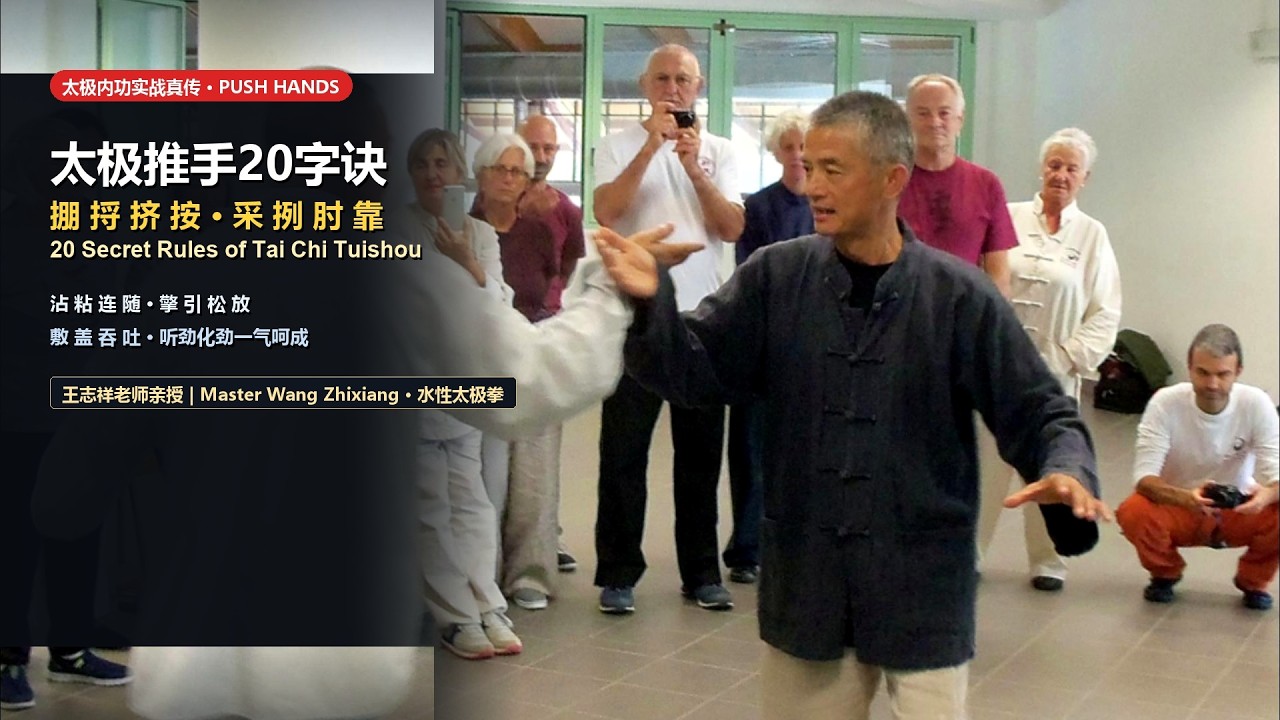
Tai Chi Push Hands (Tuishou) is the living laboratory where internal philosophy meets physical reality. Far from a contest of brute strength, authentic Tuishou tests whether a martial artist can truly 'invest in loss' (Chi Kui) by giving up muscular resistance and neutralizing force through spherical redirection. In this masterclass, Master Wang Zhixiang decodes the traditional martial formulas into practical combat applications.
- Biomechanical Efficiency: Dissolving incoming force through sticking, adhering, connecting, and following (Zhan, Nian, Lian, Sui).
- Fascial Elasticity: Cultivating Ting Jin (listening energy) to decipher the opponent's balance and intention at the moment of contact.
- Mind-Qi Regulation: Issuing explosive whole-body kinetic force (Fa Jin) without telegraphing or localized muscular strain.
📜 Complete Masterclass Lecture Transcript & Commentary
The following instructional transcript documents Master Wang Zhixiang's verbal transmission during this live lesson, segmented into core progression chapters with accompanying internal martial cues:
00:01 - 00:33 Chapter 1: Direct Technical Transmission
Alright, Tai Chi Push Hands. Ward Off, Roll Back, Press, Push. Two practitioners circling hands to feel the flow of internal power. Ward Off (Peng) Roll Back (Lü) Push (An) Press (Ji) Ward Off (Peng) Roll Back (Lü) Push (An) Press (Ji) Ward Off (Peng) Roll Back (Lü) Push and Press You must naturally switch hands during push hands.
Maintain the circular integrity of the crotch (Dang). Never allow the knees to collapse inward.
00:37 - 01:31 Chapter 2: Direct Technical Transmission
Smoothly switch hands downward following the momentum. Natural hand switching, see? Follow the momentum to switch. Light and agile hand exchange. Seamless connection. On the foundation of Ward Off, Roll Back, Press, Push, Pluck, Split, Elbow, and Bump. Pluck (Cai) Split (Lie) Pluck (Cai) Neutralize with Split Elbow (Zhou) Accelerate energy with the elbow Bump (Kao - shoulder & body strike). Bump.
Breathe through the dantian rhythm; do not force air down, allow intra-abdominal pressure to soften.
01:34 - 02:15 Chapter 3: Direct Technical Transmission
Hip Bump (Tun Kao). Hip Bump. Hip Bump. Good, and what's next? Touch (Zhan) Stick (Nian) Connect (Lian) Follow (Sui) Touch and stick without letting go Continuous and uninterrupted Yield oneself to follow the opponent Lift, Lead, Relax, Release. Lead (Yin - lure the force into emptiness). Relax (Song) Release (Fang)
Notice the subtle warmth radiating from the center; this is the awakening of Primordial Yuan Qi.
02:17 - 03:06 Chapter 4: Direct Technical Transmission
Lift, Lead, Relax, Release in one smooth breath. Spread (Fu) Cover (Gai) Spread (Mind intent blankets like water). Cover (Envelop from above). Flowing like water over everything. Swallow (Tun - absorb into void). Swallow into emptiness, dissolve into nothingness. Yes! This is the complete 20 Rules of Push Hands: Ward Off, Roll Back, Press, Push; Pluck, Split, Elbow, Bump; Touch, Stick, Connect, Follow; Lift, Lead, Relax, Release; Spread (Fu) Cover (Gai) Swallow (Tun) and Spit (Tu)! Yes, the 20 Rules fully mastered!
Stick, adhere, connect, and follow (Zhan, Nian, Lian, Sui); never resist incoming pressure head-on.
🥋 4 Fundamental Principles for Daily Practice
Integrate these four physiological anchors into every repetition of this form or exercise:
The Four Cardinal Energies (Peng, Lu, Ji, An)
Peng provides the buoyant ward-off framework; Lu yields and redirects; Ji focuses concentrated pressure; An grounds and controls downward before releasing forward.
Yielding to Conquer (She Ji Cong Ren)
Abandon stubborn resistance. When the opponent pushes your right, give way and guide their force past your centerline, causing them to fall into emptiness.
Ting Jin (Listening with the Fascia)
Listen not with the ears, but through the microscopic tactile sensitivity of your forearms and skin. Feel the opponent's root crumble before they realize it.
Subtle Coiled Spring Fajin
Internal striking does not rely on arm swings. Like water breaking through a dam or a coiled spring snapping release, explosive power discharges effortlessly from the feet and pelvis.
❓ Frequently Asked Questions by Serious Practitioners
Master Wang addresses the most common obstacles encountered when cultivating internal stillness and martial agility:
📖 Essential Internal Martial Arts Glossary (Glossario)
Key Chinese martial terminology explained through anatomical and energetic mechanisms:
| Traditional Term | English Translation | Internal Bio-Mechanical Meaning |
|---|---|---|
| Tuishou (推手) | Push Hands | The partner training system of Tai Chi designed to cultivate internal sensitivity, balance disruption, and combat readiness. |
| Peng Jin (掤劲) | Ward-Off Energy | The foundational buoyant, expansive, spherical internal quality that supports all martial applications. |
| Ting Jin (听劲) | Listening Energy | Tactile neuromuscular sensitivity capable of detecting changes in pressure, center of gravity, and vector direction. |
| Hua Jin (化劲) | Neutralizing Energy | The ability to absorb, divert, and dissolve incoming kinetic force by rotating the waist and emptying the Kua. |
| Fa Jin (发劲) | Issuing Power | The sudden, coherent discharge of whole-body internal kinetic energy originating from the ground and commanded by the core. |
Water Tai Chi is an empirical science that cannot be mastered through intellectual reasoning alone. It requires regular tactile feedback, mindful repetition, and continuous release of habitual physical holding patterns.
Subscribe to our official YouTube channel and share these teachings with fellow martial artists seeking authentic Neijia transmission.